Niagara Falls is one of the most iconic natural wonders in the world, known for its sheer power, beauty, and ability to captivate travelers from every corner of the globe. While many people visit to see the thundering waterfalls and enjoy the surrounding attractions, the history of Niagara Falls is just as fascinating as the view itself. From its geological formation thousands of years ago to its role in human culture and industry, the story of Niagara Falls is one of transformation, resilience, and enduring wonder.
The Geological Origins
The story of Niagara Falls begins nearly 12,000 years ago during the last Ice Age. As massive glaciers retreated across North America, they carved deep basins and valleys into the landscape. The melting ice released enormous amounts of water, which flowed into the Great Lakes. The Niagara River, connecting Lake Erie to Lake Ontario, eventually formed and began carrying water northward. Along its path, the river encountered a steep cliff of sedimentary rock, and as the water tumbled over the edge, the magnificent waterfalls we know today were born.
Over the millennia, the force of the water eroded the rock face, gradually moving the Falls upstream. Geologists estimate that the Falls have receded more than seven miles from their original location. While erosion continues today, modern engineering efforts have slowed the process to preserve the beauty and stability of the Falls for generations to come.
Indigenous Peoples and Early Legends
Long before European explorers set eyes on Niagara Falls, Indigenous peoples lived in the region and held the Falls as a sacred site. The name “Niagara” is believed to come from the Iroquoian word “Onguiaahra,” meaning “the strait” or “the thunder of waters.” Tribes such as the Haudenosaunee (Iroquois Confederacy) and the Neutral Nation revered the Falls, incorporating them into their spiritual traditions and oral histories.
One legend tells the story of Lelawala, a young maiden who sacrificed herself by canoeing into the waters of the Falls to honor the Thunder God who lived beneath them. Her spirit was said to have become one with the waters, and this tale became a symbol of the Falls’ sacred and mysterious power.
The Arrival of European Explorers
The first known European to document Niagara Falls was Father Louis Hennepin, a French missionary who visited in 1678. His vivid descriptions helped introduce Niagara Falls to the wider world, capturing the imaginations of those who had never seen such a natural wonder. Over the years, explorers, traders, and settlers came to the region, drawn both by the beauty of the Falls and the opportunities presented by the powerful Niagara River.
Strategic Importance in War
As European colonization expanded, the Niagara region became a critical location due to its waterways and position between Lake Erie and Lake Ontario. Old Fort Niagara, built by the French in the 17th century near the mouth of the Niagara River, became a key military outpost. Control of the fort shifted multiple times between the French, British, and eventually the Americans. During the War of 1812, the Niagara region was the site of several significant battles, cementing its importance in North American history.
Harnessing the Power of the Falls
In the 19th century, the focus shifted from military control to industrial power. As technology advanced, engineers began to harness the immense energy of the Falls for practical use. In 1895, the first large-scale hydroelectric power plant was built at Niagara Falls, and it revolutionized industry. By transmitting electricity over long distances, the plant helped shape modern electrical power systems and turned Niagara Falls into a symbol of human innovation.
Today, Niagara Falls continues to be a major source of hydroelectric power for both the United States and Canada. Carefully managed diversion systems balance the needs of energy production with the preservation of the Falls’ natural beauty, ensuring that the world can benefit from both.
A Center of Tourism
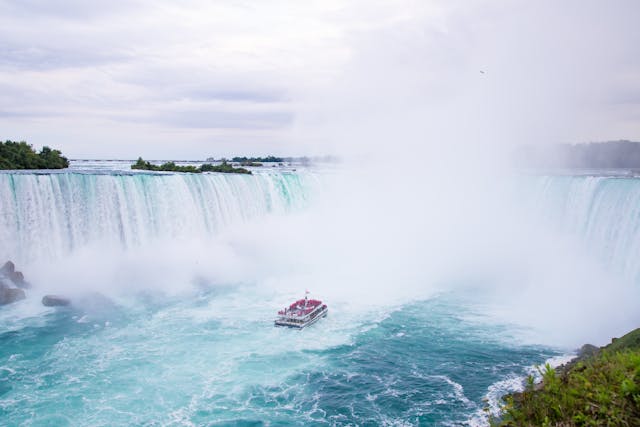
Even as industry grew, Niagara Falls also became one of the earliest major tourist destinations in North America. By the early 19th century, travelers were making their way to the Falls, inspired by stories, paintings, and early photographs. The area soon developed attractions such as hotels, observation points, and guided tours. The Maid of the Mist boat ride, first launched in 1846, remains one of the most popular attractions to this day.
With the rise of tourism came efforts to protect the Falls and surrounding land. In 1885, New York State established Niagara Falls State Park, the first state park in the United States. Landscape architect Frederick Law Olmsted, famous for designing Central Park in New York City, helped ensure that the Falls would remain free and accessible to the public. His vision of preserving natural beauty while allowing people to enjoy it still defines the park today.
Modern Niagara Falls
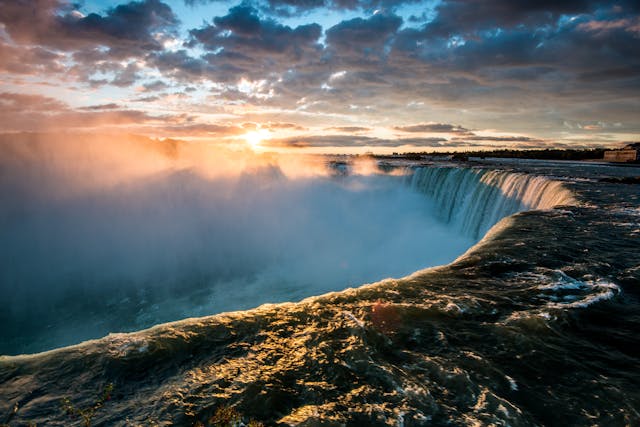
In the modern era, Niagara Falls has become more than just a natural wonder—it is a cultural icon. It has been featured in countless films, songs, and works of art, and continues to attract millions of visitors from around the world every year. Couples still flock to the Falls for honeymoons, a tradition that began in the 1800s when Niagara became known as the “Honeymoon Capital of the World.”
At the same time, the Falls serve as a powerful symbol of environmental preservation, renewable energy, and international cooperation between the United States and Canada. Attractions have expanded to include light shows, seasonal festivals, and modern visitor centers, ensuring that every generation finds new ways to connect with this timeless landmark.
The Timeless Wonder
From its ancient geological formation to its role in Indigenous legends, from a battlefield of empires to a cradle of electrical innovation, Niagara Falls has a history as powerful as its rushing waters. Its story reflects both the natural forces that shaped it and the human history that unfolded around it. While the Falls continue to evolve, one thing remains constant: their ability to inspire awe, wonder, and respect in all who stand before them.
As you gaze at the roaring waters today, you are not only witnessing a breathtaking natural wonder but also connecting with thousands of years of history. Niagara Falls is more than a destination—it is a living story of nature, people, and progress.